

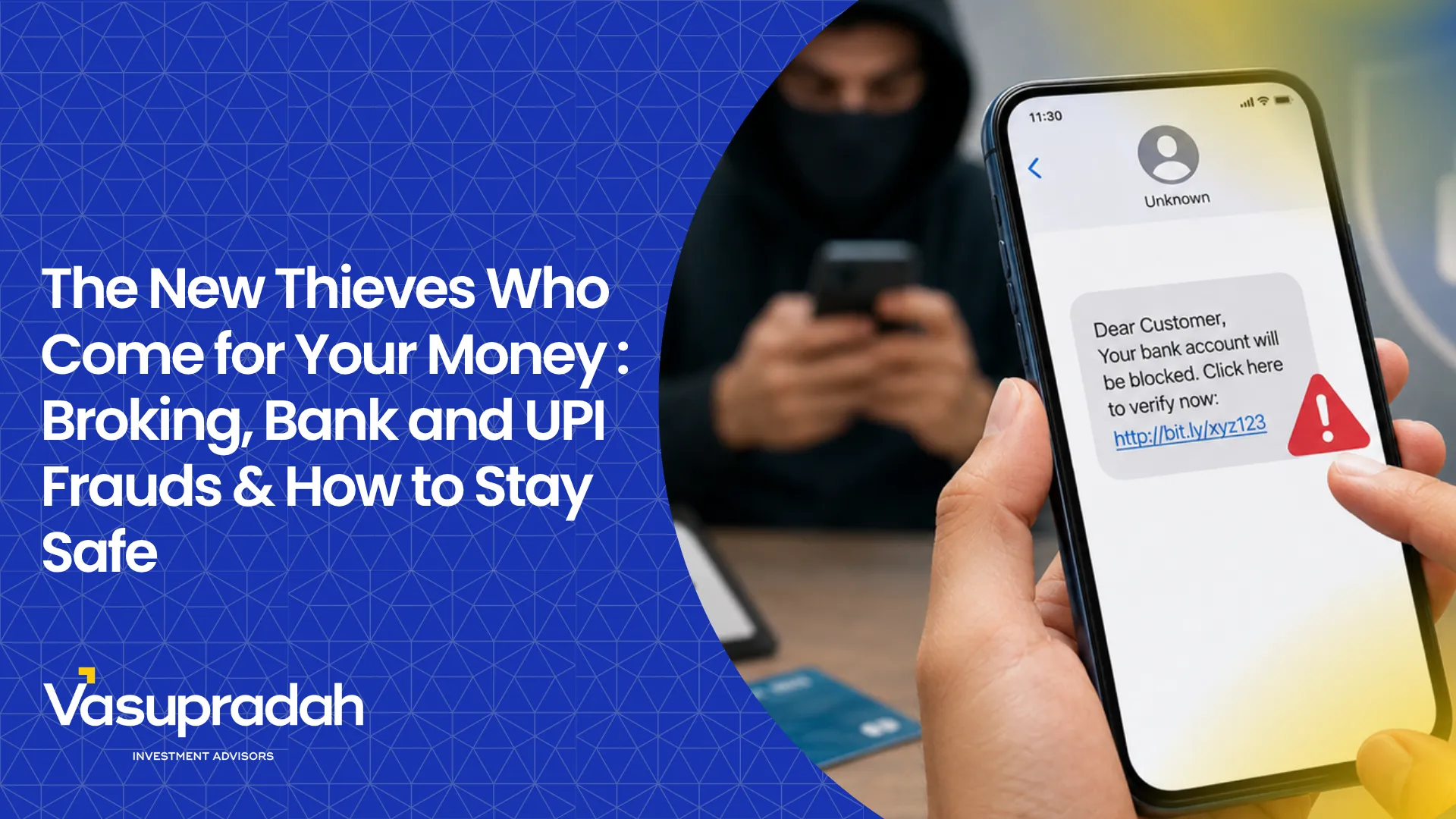
A thief who no longer breaks your lock
Gone are the days when a thief would come at night and break a lock. The era of electronic burglary is upon us, and they arrive through your smart phone — a friendly message, an invitation to an “investment group,” or as a bank alert telling you to “update your KYC immediately” , a Gas bill you missed leading to a disconnection of service into your kitchen and so on.
The most worrying part is this: the people falling for these frauds are not the uninformed. Doctors, engineers, retired officers, seasoned investors — all are becoming victims. The reason is simple. These fraudsters do not attack your intelligence; they attack your emotions — greed, fear and trust.
As a SEBI-registered investment advisor, I have seen, first-hand, the devastation these frauds leave behind. So let us look clearly at the most common broking, bank and UPI frauds operating today: how they work, what they have in common, and how you can protect yourself.
Frauds that target your investment in securities market
With ordinary people entering the stock market in large numbers, this has become one of the biggest hunting grounds for fraudsters. The main methods:
1. The “account handling” trap
SEBI itself has issued a specific warning about this. Unregistered individuals or entities approach you with an offer: “We’ll handle your trading account for you and generate assured, risk-free profits — we’ll just take a share of the gains.”
To do this, they ask for your demat and trading account login credentials. Once they have access, they place trades in your name. If there’s a profit, they take their cut; if there’s a loss, they accept no responsibility.
Remember one fundamental truth — there is no such thing as a “risk-free profit” in the stock market. The moment someone promises it, end the conversation. Make this a rule.
2. The Telegram / WhatsApp “trading group” trap
This is today’s most widespread and most dangerous fraud. Let me break down each stage — because once you understand the structure, you will never fall for it:
- The bait: An online ad or a stranger’s message adds you to a Telegram/WhatsApp group that looks highly professional and active.
- Fake credibility: The admins pose as “experts” — sometimes stealing the photo and name of a genuinely well-known analyst. Charts and “today’s profit” screenshots flow constantly.
- A small start: You’re asked to invest a tiny amount first to build trust. Sometimes they even let you withdraw a small early “profit” — this is the real hook, because now you believe completely.
- Fake proof: The group fills with “I made money!” screenshots and celebration. Most of those “members” are the fraudsters’ own fake accounts. You are the only real target.
- A fake app: You’re moved to a fake trading app or website where your “portfolio” appears to grow rapidly. But those numbers are just digits on a screen — no shares are bought, no trade actually happens.
- Scaling up: “Bigger profits need bigger investments.” People are pushed to invest lakhs — some borrow, some even mortgage their homes.
- The withdrawal trap: When you try to withdraw, you’re told to pay “tax,” a “processing fee,” or an “account upgrade” charge. Each time, more money is demanded. This is the final squeeze.
- The vanishing act: Eventually the group goes silent, the “mentors” disappear, the app stops working. The money has been scattered across many UPI accounts.
A major red flag: a genuine investment never goes into an individual’s personal UPI ID or bank account. If that’s asked, it’s a fraud.
3. Fake KYC-update messages
“Your demat account KYC has expired; update within 24 hours or your account will be frozen” — with a link. Click it and your login details are stolen or a malicious app is installed. Genuine brokers and depositories never ask you to complete an urgent KYC through a link. If in doubt, don’t touch the link — call your broker’s official number directly.
4. Fake IPO / pre-IPO share fraud
“Guaranteed allotment in this IPO,” “pre-IPO shares at a discount.” Never apply for an IPO through anyone who isn’t SEBI-registered. Every IPO application should go only through your own bank or broker, via ASBA or a UPI mandate.
Frauds that target your bank account and UPI
UPI has made India the world leader in digital payments — a genuine achievement. But the same speed and convenience is a huge opportunity for fraudsters. The main methods:
1. The “collect request” trap (the most common)
When you’re selling something online, a “buyer” sends you a payment request and tells you to enter your UPI PIN “to receive the money.”
This is the biggest lie. Never forget — you never need a UPI PIN to receive money. A PIN is only for sending money. If anyone asks for your PIN in order to pay you, it is 100% a fraud.
2. QR-code fraud
“Scan this QR code to get your refund/cashback.” The truth: scanning a QR and entering your PIN always sends money out of your account, never into it. You never scan a QR to receive money.
3. Remote-access app fraud (Any Desk, TeamViewer)
“I’m from the bank; to fix your problem, please install this app.” Once a remote-access app is installed, they get full control of your phone — they can see your screen, your passwords, your OTPs, and transact without you knowing. No bank or customer-care ever asks you to install such an app. If anyone does, hang up immediately.
4. SIM swap / clone fraud
Using your personal details, a fraudster obtains a duplicate SIM, and your OTPs start reaching them. If your phone suddenly loses signal for no reason — no calls, no SMS — call your service provider at once to verify. It can be a warning sign.
5. Phishing links / fake websites
A link to a page that looks exactly like your bank’s, sent by SMS, email or WhatsApp. Log in or enter card details there and it all goes to the fraudsters. Examine the URL carefully — a single changed character is enough. If in doubt, don’t click; open your bank’s app directly.
6. Fake app / APK-file fraud
A file sent over WhatsApp: “Install this for a reward / bank update.” Installing this APK lets it steal your SMS, OTPs and contacts. Never install an unknown file — use only the official Play Store or App Store.
7. “Digital arrest” — the cruellest new fraud
A video call from someone claiming to be the police, CBI, customs or TRAI — sometimes with a fake police station in the background. “An illegal parcel was found in your name,” “your Aadhaar was used for money laundering.” Then: “You are now under digital arrest. Don’t leave the camera, don’t tell anyone.” For hours — sometimes days — they terrify the victim into transferring money “to prove your innocence.”
Hear this clearly — there is no such thing as “digital arrest” in Indian law. No real police officer arrests you over a video call, demands money, or tells you to keep it secret. If such a call comes — don’t panic. Cut the call, tell your family, and report to 1930.
The common signatures of every fraud (learn these and you’re safe)
Whatever form they take, almost all frauds share these signs. If you spot even one, a red light should come on:
- Promise of assured / risk-free returns — impossible in real markets.
- Urgency and pressure — “act now or you’ll lose out.” Hurry is designed to stop you thinking.
- Asking for PIN, OTP, password or CVV — no genuine institution ever asks for these.
- Money to a personal account — no legitimate investment goes to an individual’s UPI/bank account.
- Asking for more money to withdraw your money — fees, tax, upgrades. A guaranteed scam.
- Screenshots as “proof” — a profit screenshot is not evidence; it’s faked in seconds.
- No registration — no SEBI/RBI registration, no deal.
Practical ways to protect yourself
On the stock-market side
- Never share your demat/trading login, password or OTP with anyone — no advisor, no “account handler,” no one.
- Deal only with SEBI-registered intermediaries; verify registration on SEBI’s official website.
- Use only authentic, verified apps (via the official app store).
- Stay completely away from Telegram/WhatsApp “trading groups.”
- When you take advice, make sure it suits your own risk profile — what’s right for one person can be wrong for another.
On the bank/UPI side
- Never share your PIN, OTP or CVV — no matter who calls.
- Never enter a PIN to receive money.
- Don’t install remote-access apps (AnyDesk, TeamViewer) on anyone’s instruction.
- Don’t click unknown links or install .apk files.
- Avoid bank/UPI transactions on public Wi-Fi.
- Set a daily limit on UPI/cards; turn on transaction alerts.
- Don’t keep your main savings in your everyday UPI account — keep only a small amount there, so any fraud causes only limited loss.
If it happens: the “golden hour” is everything
If you realise you’ve been defrauded, don’t stay silent out of shame — that shame is the fraudster’s greatest ally. What matters most is speed.
The first few hours after a fraud are called the “golden hour.” Report within this window and there’s a far higher chance the money can be frozen and recovered before it’s moved on. Every minute counts.
Do this immediately:
- Call 1930 — the national Cyber Crime Financial Fraud helpline, open 24×7. Save this number in your phone now.
- Register a complaint at cybercrime.gov.in.
- Inform your bank at once — give the transaction details, get the account/card blocked, and obtain a complaint reference number.
- Preserve all evidence — SMS, screenshots, call numbers, UPI IDs, transaction IDs.
- If it’s a stock-market/SEBI-related fraud, also file through SEBI’s SCORES platform.
Doubt is not rude — it’s armour
These fraudsters are clever, and their methods change by the day. But they have only one weapon — our own hurry, greed and fear. So the greatest protection is this: pause for a moment, think, and doubt.
If an offer is too good to be true, it almost certainly isn’t true. Before you send money, before you enter a PIN, before you click a link — stop and ask yourself: “Why is there so much hurry about this?” That single question, that one moment of caution, can protect years of your savings.
Please share this with the people you love — especially the elderly, who are the easiest targets. It may just save them from a devastating loss.
Key numbers (note them down)
- Cyber Crime Financial Fraud Helpline: 1930
- Complaint portal: cybercrime.gov.in
- SEBI investor grievances: SCORES (scores.sebi.gov.in)