



When families sit down with financial advisors to plan their futures, the conversation almost always starts with a frantic question: “Which fund is the best?”.
However, diving straight into fund selection is like building a house without blueprints. Before looking at a single fact sheet, investors need a structured wealth architecture.
1. The Master Switch: Asset Allocation
The foundation of any sound investment strategy isn’t fund selection; it is Asset Allocation.
Before a single rupee is deployed, investors must determine the exact split between:
- Growth Assets (Equity): Designed to capture long-term growth and beat inflation.
- Defensive Assets (Debt): Ranging from liquid funds to gilts and bonds, serving as the financial anchor to reduce volatility.
Getting this ratio wrong undermines even the best fund choices. An overly aggressive portfolio often leads to panic-selling during market bottoms. The right asset allocation must be customized based on an investor’s life goals and time horizon.
2. Targeting Return Pools: Defining the Strategy
Once the equity-debt split is locked in, the focus shifts to selecting investment strategies that target reliable Return Pools—systematic areas backed by financial research, risk rationales, and historical data. Think of Return Pools as water holes, where you can be assured to find water in a season, if not always.
In equity investing, the Fama-French Model is a cornerstone framework. It demonstrates that portfolios can target excess returns by focusing on specific factors:
- Market Risk (The Broad Market): Just being invested in the markets attaches a premium to your earnings.
- Size Premium: Smaller firms carry higher business risk, but the market compensates for this over the long run with higher structural returns (captured via Mid and Small Cap allocations).
- Value: Captures the historical tendency of value stocks (companies with high book-to-market ratios, meaning they are priced cheaply relative to their assets) to outperform growth stocks.
- Profitability: Compares companies with high (robust) operating profitability against those with low (weak) profitability, showing that highly profitable firms tend to yield higher average returns.
- Investment Factor: Looks at corporate asset growth. Companies that invest conservatively (cautious asset growth) historically outperform those that grow aggressively through heavy capital expenditures.
Other notable academic models highlight factors like Momentum and Quality. Because no single factor outperforms in all market conditions, a well-rounded portfolio combines these strategies rather than relying on just one.
3. The Core Portfolio: Spanning the Size Spectrum
A robust equity portfolio, for example, builds outward from a solid core:
- Large Caps as the Bedrock: Represented by indices like the Nifty 100 (which covers roughly 65% of the total market capitalization), large caps offer stability and high liquidity through established businesses. The Large Cap returns over last 5 years show clustering of returns but lower volatility (as compared to mid and small caps).
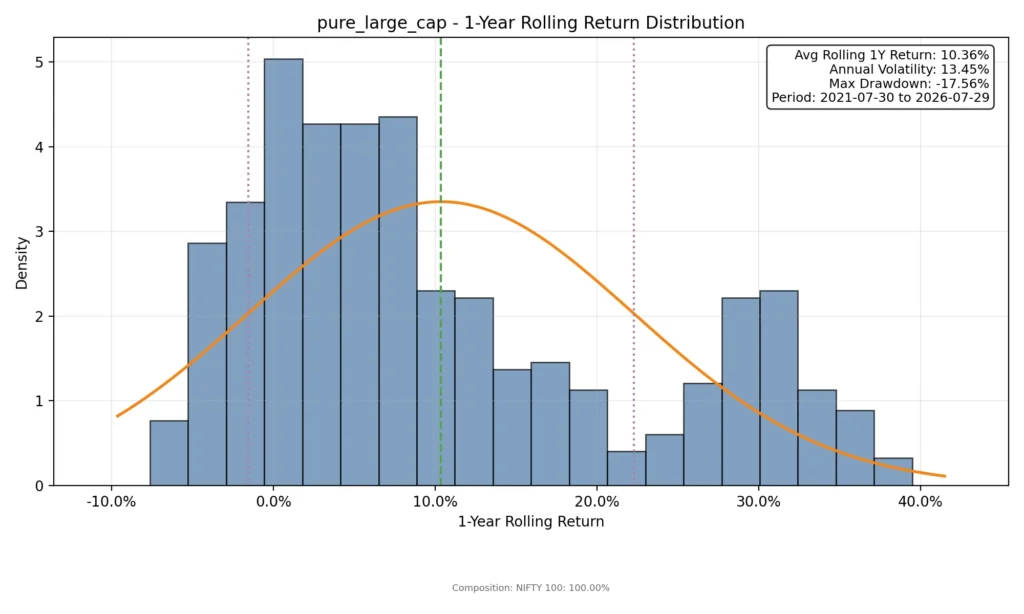
- Capturing the Size Spectrum (Mid & Small Caps): While large caps stabilize, stopping there misses out on the Size Premium. Layering in mid and small-cap funds acts as the growth engine. However, moderation is key: going overboard with small caps introduces extreme volatility, which can quickly erode capital during a market downturn.
A look at the returns from Small Cap shows they are spread out over a wider range rather than tightly clustered around the centre. a flatter curve relative to a standard bell curve signals higher uncertainty and wider outcome variability—meaning returns are less predictable.
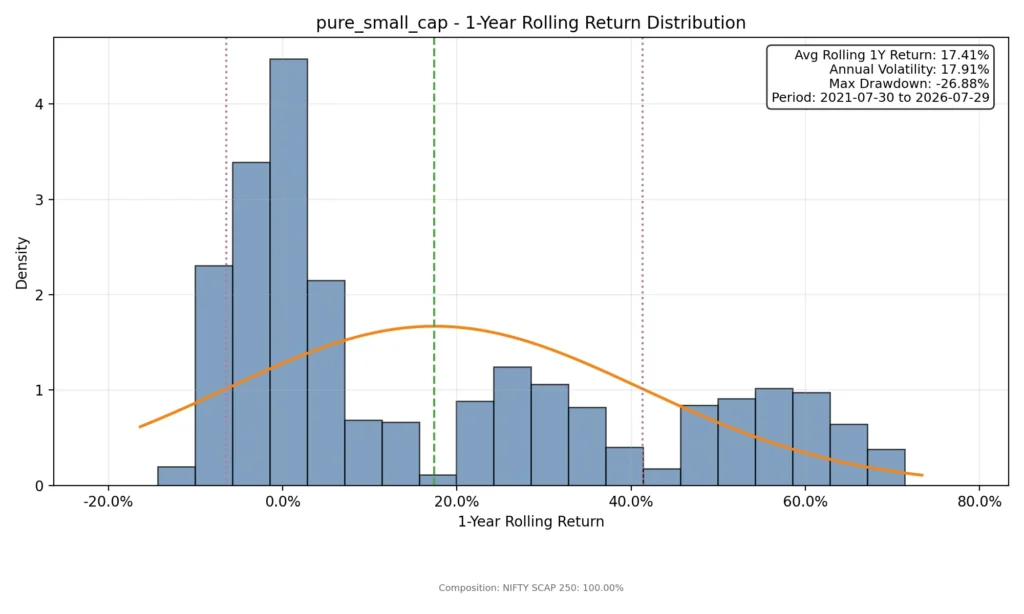
A 27% max drawdown in small-caps means wiping out over a quarter of your capital in one stroke, enough to rattle the confidence of even the most seasoned investors. A blend of large, mid and small, moderates the returns but brings more control in terms of variability.
4. Capturing other factors
Investors often wonder if they need separate buckets for “Value”, “Growth” or “Quality”. Investing on mutual funds gives an advantage. Good fund managers continuously evaluate book-to-market ratios, profitability, and quality and that is ingrained in the selection process. That obviates the need to buy separate dedicated funds targeting these factors.
5. The Satellite Portfolio: Thematics and Diversifiers
If the Core handles broad market capitalization, Satellite plays act as the tactical wild cards—like spices in a meal, meant to enhance rather than dominate.
- Thematics & Sectoral Funds: Can dramatically boost performance when a market cycle aligns in their favour, but they carry high non-systemic risk.
- Diversifiers (Gold & Foreign Funds): These act as shock absorbers. Exhibiting low correlation to the broader equity cycle, they protect portfolios during extreme market mood swings.
Because satellite investments are difficult to predict and prone to long cycles of under performance, advisors recommend capping satellite exposure at 5% to 15% and monitoring them actively.
6. Rebalancing & Mean Reversion
A Core-and-Satellite architecture does not run on autopilot. Markets constantly shift, and asset factors inevitably revert to the mean. When a particular segment lags for a few years, it is often quietly setting up for a comeback. Disciplined rebalancing—trimming exposure to assets that have outrun their targets and shifting capital into recovering areas—is what ultimately keeps a wealth architecture intact over the long term. Building a Mutual fund portfolio should start with defining the investment objective. The investment objective leads to the asset allocation strategy. Once the percentage of assets to be invested is decided (say 70% in equity), the investment strategy should be decided. The investment strategy should aim at capturing the return-pools available in the market. The picking up of the final funds comes as a last step…. which, as it happens, is often the first question to be asked!
Disclaimer:
The information provided in this article is for educational and informational purposes only and should not be construed as investment advice, or a recommendation to buy or sell any specific mutual fund or security. Mutual fund investments are subject to market risks. Read all scheme-related documents carefully before investing. The graphs represent a window between 2021–2026 which is relatively short (5 years) and heavily influenced by post-pandemic market cycle.