

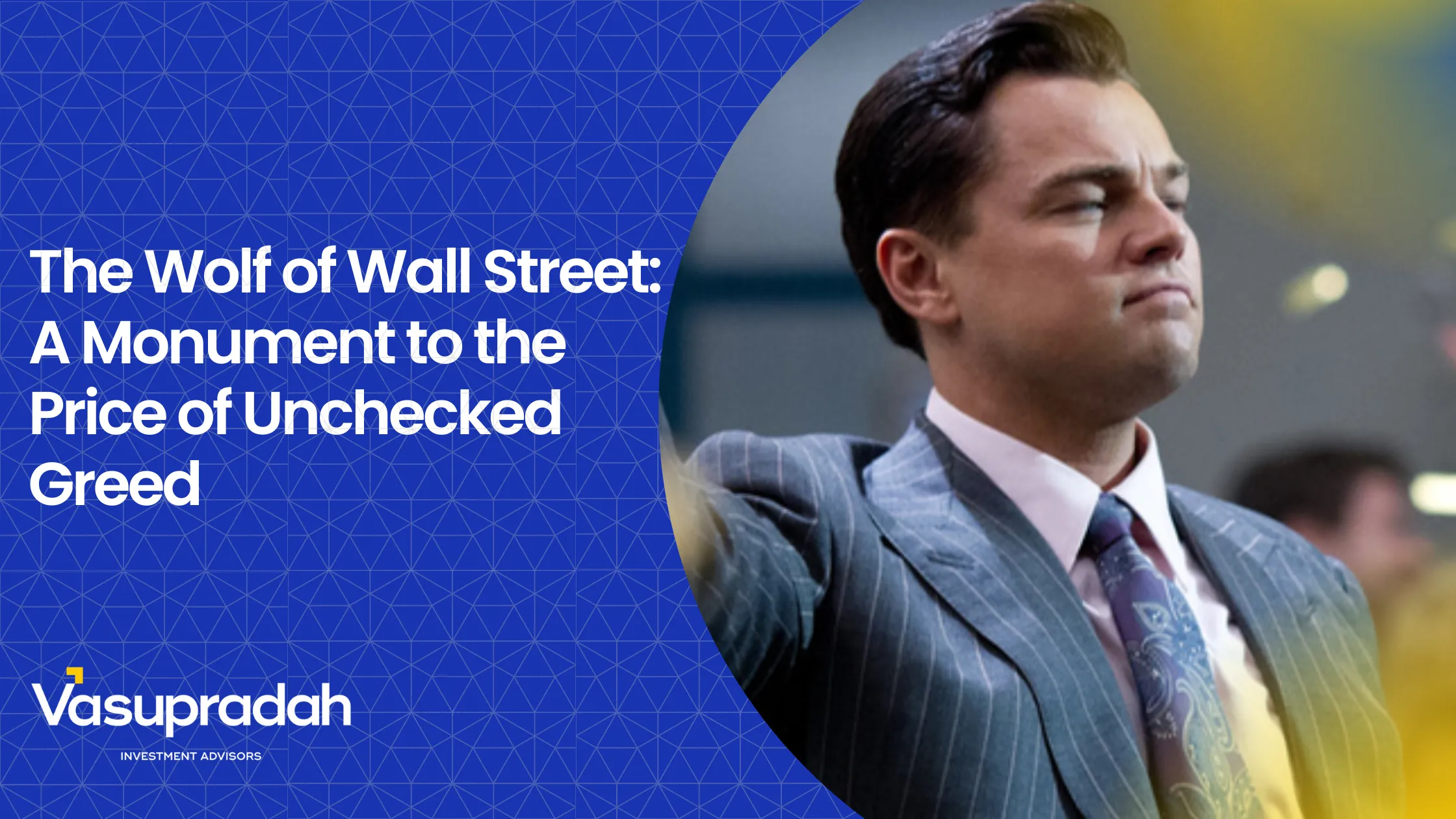
Jordan Belfort’s story is often misunderstood. In popular culture, it is frequently viewed as a rebellious joyride of excess, a celebration of how far charisma can take you. But strip away the Hollywood veneer, the yachts, the substances, and the adrenaline & you are left with a darker, more brutal truth about human nature & financial markets:
If your investment thesis is built solely on greed, your portfolio is not building wealth; it is engineering a collapse.
Belfort didn’t deal in assets; he dealt in aspirations. He understood that the average person doesn’t want steady compounding; they want a lottery ticket. He didn’t sell stocks based on intrinsic value; he sold stories wrapped in urgency, glamour, and the terrifying fear of missing out (FOMO). People lost their life savings not because the “market” crashed, but because they abandoned logic to follow a mesmerizing narrative.
This is the trap, the “honey pot” that every retail investor must recognize & avoid.
1. Lesson for Investors: Conviction Must Come from Calculation, Not Charisma
The victims of Stratton Oakmont were not buying businesses; they were buying hope.
They bought into the “Pink Sheets” (penny stocks) because Belfort convinced them that a $5 stock was a guaranteed path to $50. There was no discussion of cash flows, debt levels, or earnings quality. There was only the seductive illusion of being “early” to the next big thing.
The Modern Parallel:
Today, the “Wolf” doesn’t call you on a landline. He lives in Telegram groups, YouTube comment sections, and “Insider Tip” WhatsApp channels.
- “Guaranteed 20% monthly returns”
- “The next multi-bagger that big institutions are hiding from you”
- “Buy now before the news breaks”
The Reality Check:
True investing is often boring. It involves reading annual reports, understanding competitive advantages (moats), and waiting years for a thesis to play out.
Due Diligence is the only vaccine: If you cannot explain how the company makes money to a 10-year-old, you have no business owning the stock.
If a stock requires a high-pressure sales pitch to be attractive, it is not an asset – it is bait.
2. Lesson for Advisors & Professionals: The “Churn” vs. The “Compound”
The most chilling scene in the story isn’t the debauchery; it is the philosophy Belfort teaches his brokers: “Move the money from the client’s pocket into your pocket.”
Stratton Oakmont made its fortune on turnover. They needed clients to sell good stocks and buy bad ones, over and over again, to generate commissions. This is the antithesis of wealth creation.
The Fiduciary Standard:
A true financial advisor succeeds only when the client succeeds. In the real world, wealth is built through inactivity by buying high-quality assets and sitting on them for decades.
- Trust is the Asset: A broker who stops a client from making a bad trade during a panic is worth infinitely more than a broker who suggests a “hot trade” during a bull market.
- Relationships built on hype dissolve when the market turns. Relationships built on transparency and education survive the crash.
3. Lesson for Traders: The “God Complex” and the Law of Gravity
Jordan Belfort didn’t blow up his life because of a single bad trade. He was destroyed by the normalization of extreme risk.
In the markets, early success is dangerous. It breeds a “God Complex.” When you win big on a gamble, your brain rewires to believe you are a genius, rather than just lucky.
The Explosive Mix:
Belfort treated leverage (debt) and illegal maneuvering as standard operating procedure. He ignored the small cracks in the dam because the water level kept rising.
Risk Management: A trader who makes 500% in a year but has no “brake pedal” will eventually go to zero. It is a mathematical certainty. The goal is not just to make money, but to keep it.
Ego is the Enemy: The market is a humbling machine. It tolerates ignorance for a while, but it punishes arrogance swiftly and severely.
The Core Message: Speed vs. Direction
The ultimate tragedy of The Wolf of Wall Street is that for all the money generated, nothing of value was created. It was a transfer of wealth from the naive to the predatory, fueled by the drug of instant gratification.
The Philosophy for the Long-Term Investor:
- Greed provides Speed: It pushes you to take massive risks for quick dopamine hits. It feels like flying, until you hit the mountain.
- Discipline provides Direction: It feels slow. It requires saying “no” to hot tips. It requires patience when others are bragging about quick gains.
But in the grand timeline of your financial life, remember this:
As we enter a New Year 2026, it is time for us to remind ourselves that wealth is not the speed at which you reach the destination; it is the certainty that you will arrive there intact. Choose the path of the tortoise, not the wolf. The wolf always ends up in a cage either literally, or in the prison of his own anxiety.
Wishing you a very Happy and Prosperous New Year 2026!
